Mounting and Cooling
Thermal management is critical to the real-world performance of an ESC. This section is intended to provide a simplified method to estimate the cooling required to achieve the desired performance and should be considered indicative only.
Unit Mounting
Four M3 [#3-48] screws should be used to mount the nanoDRIVE 4LPi to the frame of the drone. Ensure you use a tightening torque appropriate to the fastener and mounting material you are using. The mounting holes accommodate a head diameter/washer diameter of 5 mm [0.19 in].
The bare board contains numerous exposed contacts, including those of component leads. Ensure there is adequate electrical insulation to prevent hazardous short circuits. As a rule of thumb, there must be minimum 0.6 mm [0.023 in] air gap between exposed contacts and any conductive materials in the mounting assembly. All direct contacts to the unit, especially the thermal interface materials (TIM), must be electrically insulative. Keep-out zones for the nanoDRIVE 4LPi can be found in the CAD available from our datasheet.
The nanoDRIVE 4LPi is a bare-board motor controller with exposed electrical connections. Contact with water or significant amounts of dust/particulate can result in unit failure. Ensure that the unit is mounted in a location with appropriate environmental protection to reflect the UAV’s operating conditions.
Thermal Zones
The heat generating zones on the nanoDRIVE 4LPi are highlighted on the drawing below. Heat is generated primarily from the 24 MOSFETs, located on both sides of the device along the edges. The 2 electrolytic capacitors on the top side, and 4 microcontrollers on the bottom side are secondary heat sources.
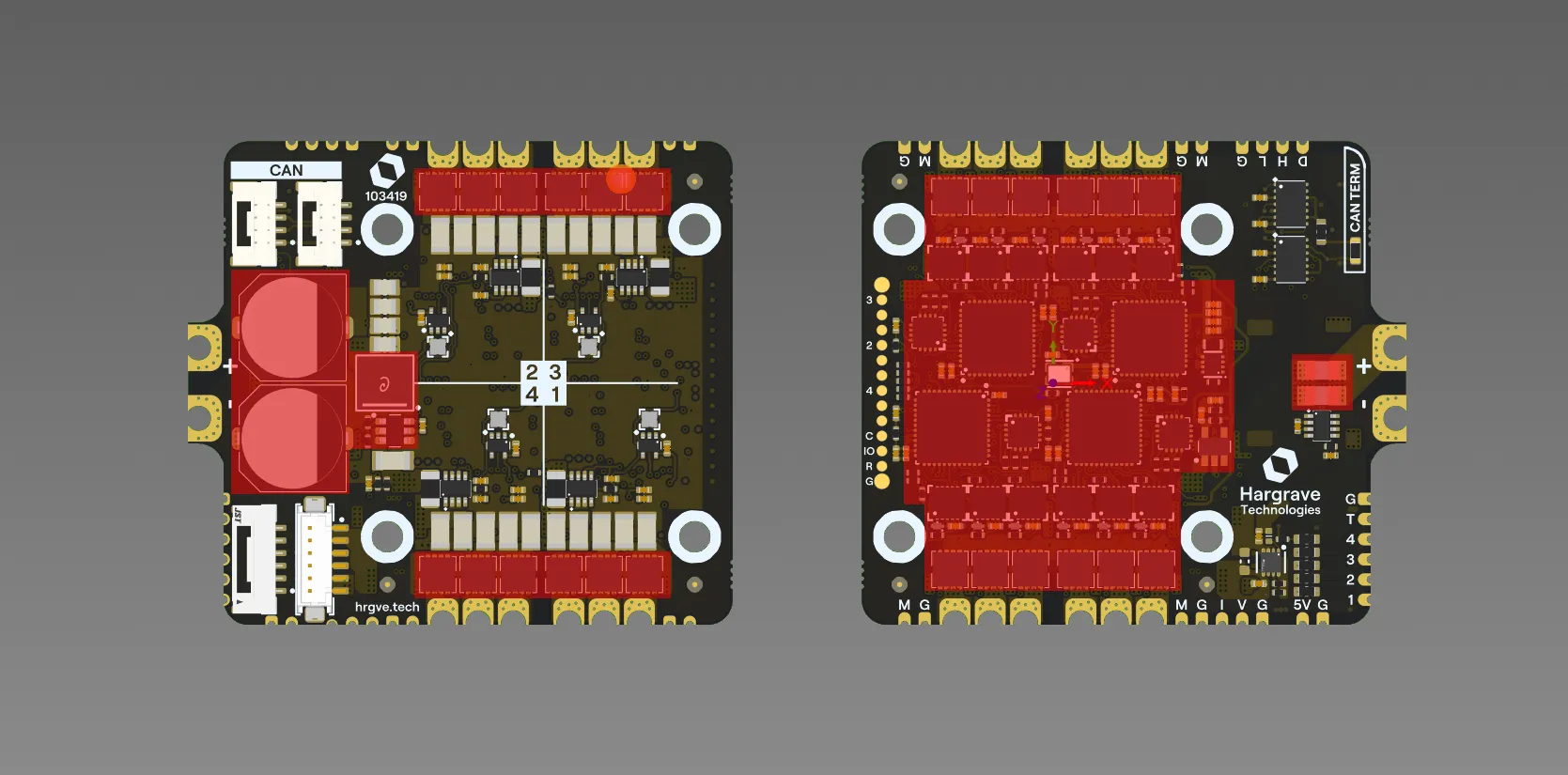
The recommended thermal solution is a heatsink applied at the MOSFETs and microcontrollers on the bottom side. The through board conductivity is used to cool the MOSFETs on the top side.
The thermal solution should make contact with all components shaded red, through a thermal interface material (TIM) such as a thermal pad or paste. The selected TIM should be:
- A thermal resistance of no greater than 62.5mm2 K/W
- not electrically conductive
Our recommended pad is the Laird Tflex SF10, 0.5mm thickness. Make sure to check compatibility with mounting surfaces/materials used. Always follow manufacturer instructions for installing a TIM. For a detailed guide on how to mechanically mount the nanoDRIVE 4LPi in a vehicle, see our datasheet.
The nanoDRIVE 4LPi can also be effectively cooled with direct forced convection. In this case, the unit should be positioned with the top side exposed to perpendicular flow, either through propeller wash, induced airflow or fans. A considerable amount of airflow is required to achieve the full performance of the motor controller.
It is important to have a good thermal connection between the MOSFETs and the microcontrollers. in order to more effectively monitor MOSFET temperature. In direct airflow applications, this may require the addition of a thin heat spreader on the underside of the board to bond the MOSFETs to the microcontrollers
Thermal Output
The nanoDRIVE 4LPi has a particularly high power density, making effective cooling a challenge. To ensure the nanoDRIVE 4LPi can operate continuously at the required phase current, you need a cooling solution that can effectively dissipate the thermal power from the unit to ambient. It must do so while keeping the MOSFET's and the electrolytic capacitors within their operating temperature. To find power dissipation and temperature limit calculations, please consult our technical datasheet.